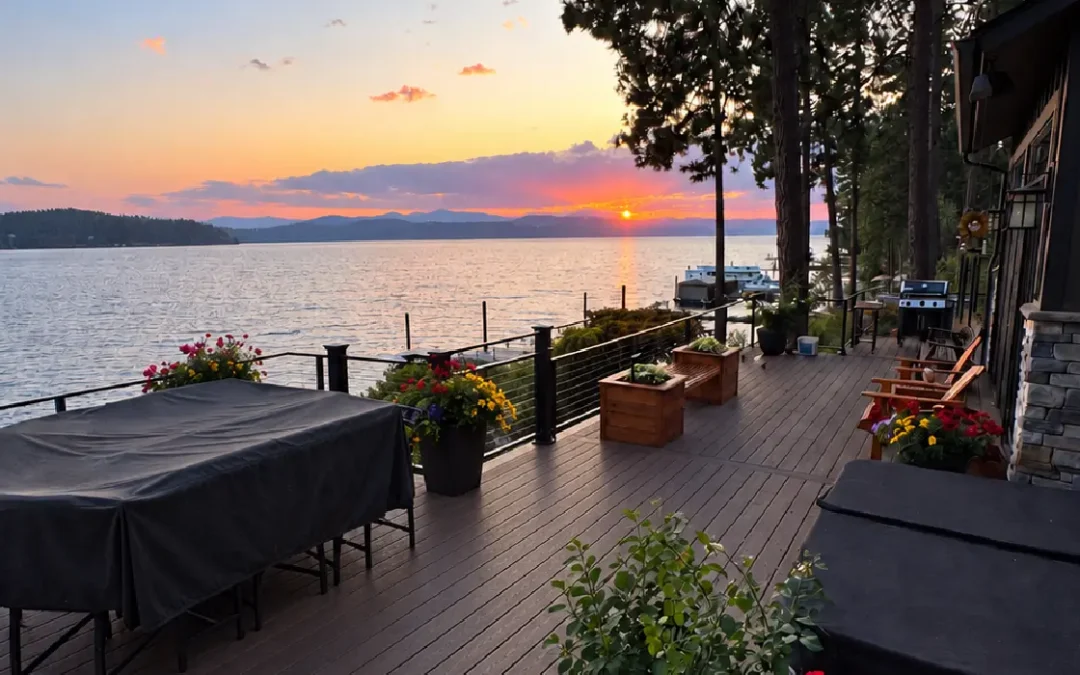
Few things beat morning coffee on a deck over Lake Coeur d’Alene, Lake Pend Oreille, Hayden Lake or Priest Lake. But building on the water comes with more rules than any other lot in North Idaho. Shoreline buffers decide where the house can sit, the state decides how big your dock can be, and seasonal lake levels affect everything from the foundation to the boat lift.
Premier Quality Homes has built lake homes around Coeur d’Alene, Hayden, Harrison, Sandpoint, Sagle and Priest Lake. Here’s what to know before you buy or design a lakefront home.
Shoreline setbacks: where your home can sit
The county sets how close you can build to the water. In both counties, distances are measured from the ordinary high water mark, not from wherever the water happens to be the day you visit.
Kootenai County (Coeur d’Alene, Hayden Lake, Spirit Lake, Harrison and the Spokane River)
- A 25-foot shoreline management area, measured along the slope, runs landward from the high water mark.
- Inside that zone: no mechanical ground disturbance, no fertilizer on lawns, and no chemical storage.
- Allowed: one stairway or walkway and one tram per parcel, plus one more set for each additional 250 feet of shoreline. Stairs and walkways are limited to 4 feet wide and landings to 6 feet.
- View trimming: trees can be limbed up to one-third of their height, across no more than one-third of your shoreline.
- Larger work in the zone needs a shoreline management plan prepared by a design professional.
Bonner County (Lake Pend Oreille, Priest Lake and the Pend Oreille River)
- Any lot within 200 feet of the high water mark is “shore land.” Your Building Location Permit needs a Shore Land Development Worksheet.
- A 40-foot vegetative buffer along the shoreline must keep native vegetation or be replanted to a landscape plan.
- Impervious surface limit: roofs, driveways and patios are capped at 35% of the shore land area. The cap rises to 52½% if every structure sits at least 75 feet back.
- Floodplain lots also need a Floodplain Development Permit, with plans stamped by an Idaho-licensed engineer or architect.
If your lot is inside city limits, such as Coeur d’Alene or Sandpoint, the city’s own shoreline rules apply instead. See Kootenai vs Bonner County Building Permits for how each county’s permit process works.
Docks and shoreline work: the state’s permit
The lakebed below the high water mark belongs to the State of Idaho. Under the Lake Protection Act, any dock, boat lift, buoy, water intake line or shoreline stabilization on a navigable lake needs an encroachment permit from the Idaho Department of Lands (IDL).
Single-family dock limits (IDL handout, 2025)
- Size: no more than 700 square feet of decking waterward of the high water mark
- Width: no part of the dock wider than 10 feet, not counting the slip cut-out
- Length: can’t extend past the line of navigability, which is usually set by the length of existing permitted docks nearby
- Distance from neighbors: at least 10 feet from the adjacent littoral (shoreline) property lines, unless the neighbor agrees in writing
- Lifts: one boat lift and two jet ski lifts, or two boat lifts. Extra lifts count against the 700-square-foot limit.
- Fee: $425 to apply. Transferring an existing permit to a new owner costs $300.
Good to know
- If a neighbor files a written objection within 10 days, IDL holds a formal hearing, which can add weeks.
- On Lake Pend Oreille, you’ll also need a U.S. Army Corps of Engineers permit for docks and water lines.
- Riprap, seawalls and other bank stabilization also go through IDL. In Kootenai County, softer methods like willow walls, coir rolls and cobble with native plants are allowed in the shoreline zone.
- Buying a home with an existing dock? Make sure its permit transfers to you, and check whether it’s legally permitted at all. Older docks can need proof of age.
Septic and wells near the water
On many lake lots, the septic system, not the house, decides the layout. Panhandle Health District (PHD) permits every system and enforces state separation distances from surface water.
- Drainfield: typically at least 100 feet from the lake’s high water mark
- Septic tank: typically at least 50 feet from the high water mark
- Wells: septic components usually need about 100 feet of separation from drinking water wells, both yours and your neighbors’
On a narrow lot, fitting the house, drainfield, well and 25- or 40-foot shoreline buffer together can be tight. Some lakefront homes need pressure distribution or advanced treatment systems, or connect to a local sewer district where one is available. Get a PHD site evaluation before you buy. Costs and details are in our post on wells, septic and utilities on raw land.
Lake levels, flooding and erosion
North Idaho’s big lakes rise and fall on a schedule set by dams downstream. That affects your dock design, your boat lift and how much shoreline you’ll see in winter.
- Lake Coeur d’Alene: Avista’s Post Falls Dam holds the lake at or near 2,128 feet through summer. Drawdown begins after Labor Day, and in winter and spring the lake finds its own natural level, which can swing widely during runoff.
- Lake Pend Oreille: the Army Corps of Engineers’ Albeni Falls Dam keeps summer pool around 2,062 feet. Fall drawdown starts in mid to late September and brings the lake down to about 2,051 feet, roughly 11 feet lower, by mid-November.
- Priest Lake and Hayden Lake: each has its own seasonal pattern and high water mark. Ask a local dock builder or IDL what to plan for on your stretch of shoreline.
What this means for your build?
- Design docks to handle the full range of water levels. Floating sections, adjustable ramps or seasonal removal are common on Pend Oreille.
- Keep the house, especially the lowest floor and mechanical equipment, well above high water and outside mapped floodplain where you can.
- Wave action and winter ice erode banks. Plan shoreline protection early, and permit it through IDL.
- Many lake lots are steep. Retaining walls, engineered foundations and drainage add cost; see building on sloped lots.
Designing a home for the lake
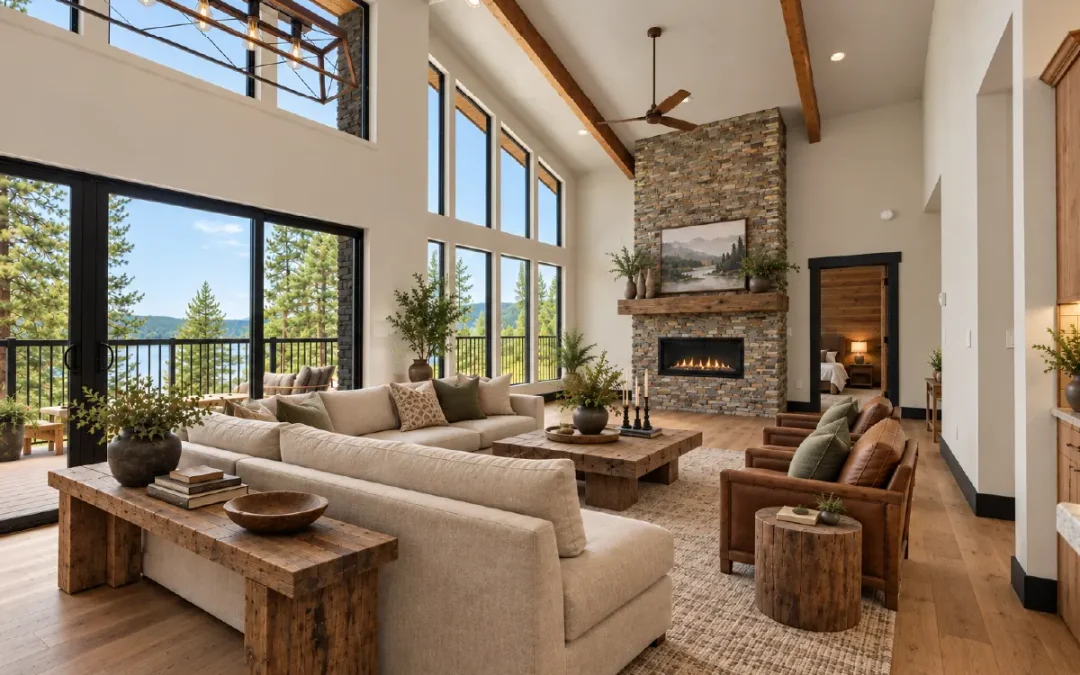
- Orient for the view and the sun. Big lake-facing windows need the right glass and overhangs so rooms don’t overheat on summer afternoons.
- Plan the walk to the water. Stairs, paths and trams are limited in the shoreline zone, so design the route from house to dock early.
- Build for wind and weather. Lake sites take more wind, driving rain and snow. Durable siding, a well-sealed exterior envelope and covered outdoor living pay off.
- Think about wildfire too. Many lake lots back up to forest. See our post on wildfire resistant custom home design.
- Store the toys. Boat and gear storage, a mudroom and an outdoor shower make lake living easier.
Lakefront permit checklist
- Locate the ordinary high water mark on your survey
- Confirm whether the lot is in city limits, Kootenai County or Bonner County
- Map the shoreline buffer (25 feet in Kootenai County, 40 feet plus the 200-foot shore land area in Bonner County)
- Order a Panhandle Health District site evaluation for septic
- Check floodplain and wetland maps
- Apply for the IDL encroachment permit for your dock, lifts or shoreline work, plus a Corps permit on Lake Pend Oreille
- Confirm any existing dock is permitted and transferable
- Plan stairs, tram and paths within what the county allows
Still deciding between the water and wide-open acreage? Read Lakefront vs Acreage Living.
Build your lake home with Premier Quality Homes
Since 1995, we’ve helped North Idaho families build on the water. We coordinate the survey, septic, shoreline plans and permits, so your home fits the lot and the rules from day one.
Kootenai County lake areas we serve
Bonner County lake areas we serve
Looking at a lake lot? Contact us or call (208) 819-5172, and we’ll walk it with you before you buy.
Frequently asked questions
How close can I build to the lake in Kootenai County? Kootenai County keeps a 25-foot shoreline management area, measured along the slope from the high water mark. No ground disturbance or structures are allowed there beyond permitted stairs, walkways and a tram.
What are the shoreline rules in Bonner County? Lots within 200 feet of the high water mark need a Shore Land Development Worksheet. A 40-foot vegetative buffer applies, and impervious surfaces are capped at 35% of the shore land area, or 52½% if structures sit 75 feet back.
Do I need a permit for a dock in Idaho? Yes. Docks on navigable lakes need an Idaho Department of Lands encroachment permit. The application fee is $425. Docks on Lake Pend Oreille also need an Army Corps permit.
How big can my dock be? Under IDL’s single-family dock guidelines, up to 700 square feet of decking past the high water mark and no wider than 10 feet. It must stay within the line of navigability and at least 10 feet from neighbors’ littoral lines.
How far does Lake Pend Oreille drop in winter? The Army Corps typically lowers it from about 2,062 feet in summer to about 2,051 feet by mid-November, roughly 11 feet.